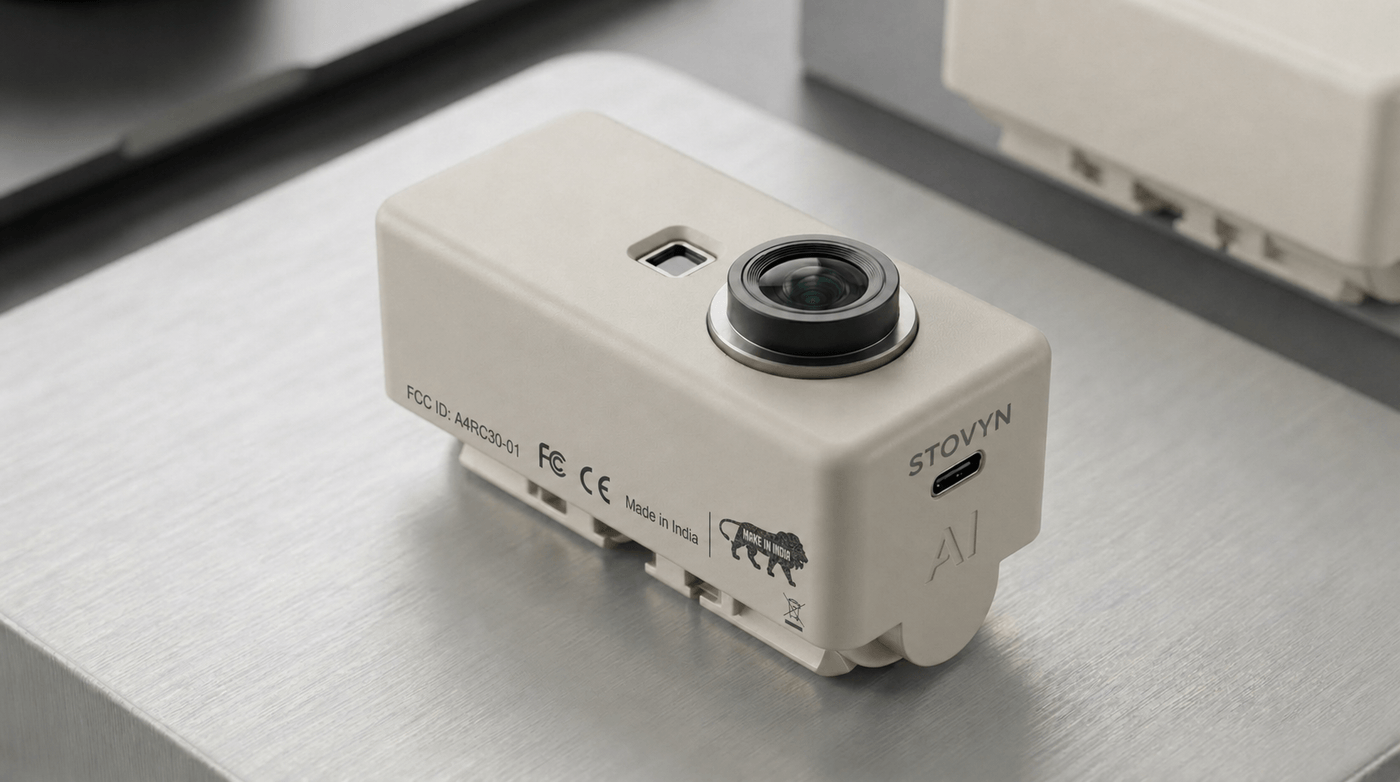
Stay close to your stove, even when you step away.
Peace of mind at the stove. Stovyn notices when it's left on and reaches your loved ones if you can't.
Two ways to watch over the stove.
On-device stove safety.
No video streaming.
Thermal sensing with AI context catches unattended cooking and escalates to the people who can help — Pro adds a camera, and neither model streams video.
Pre-order now — ships October 30, 2026.
Get notified when Stovyn ships. No spam, one email at launch.
Stovyn Pro
Thermal and Camera AI
Thermal anomaly detection · Motion confirmation · Escalation logic
Life pulls you away from the stove.
Stovyn watches the burners so you don’t have to.
Phone call pulls you away
15 minutes becomes 30
Kids need immediate help
Stove forgotten entirely
Quick errand takes longer
Heat builds up unnoticed
The numbers are clear.
Cooking is the #1 cause of home fires.
NFPA annual averages, 2017 to 2021
Cooking Share
Unattended Factor
Equipment Involved
Unattended cooking drives ~48% of cooking-fire deaths.
The single largest contributing factor.
Ranges and cooktops involved in 88% of cooking-fire deaths.
Apartments account for ~47% of home cooking fires.
Source: NFPA Research (Home Cooking Fires, 2017 to 2021 annual averages)
Why it matters: Unattended cooking is a leading cause of kitchen fires.
How it works.
The whole flow, start to finish.
Your trusted contacts, notified in order of priority.
Local alarm and escalation are both configurable in settings.
Choose your Stovyn.
Standard or Pro.
Standard
Thermal-only detection
- Thermal and whistle detection
- Smart alerts and escalation
- Best for most homes
Pro
Thermal and Camera AI
- Everything in Standard, plus:
- On-device camera (no streaming)
- Better in complex kitchens
Our progress
Where Stovyn is right now
Here’s where we are in building Stovyn, updated as we go. Tap any step to see what it involves.
Estimated ship date: October 30, 2026
Estimated — subject to regulatory approvals
For every Stovyn sold, we pledge $1 to firefighters.
You nominate and vote for the fire service that receives it.
Illustrative scenarios
Real-world scenarios.
When Stovyn makes a difference.
Examples for illustration. Photos are stock imagery, not actual customer incidents.
Your fan makes a sound.
Stovyn is listening for it.
No other stove monitor knows whether your range-hood fan is actually running. Stovyn recognizes its sound signature — and uses that to protect you when it matters, and to keep your kitchen cleaner every day.
When a fire starts
Flames or smoke with the fan off is the worst combination: nothing is pulling smoke or carbon monoxide out of the room. Stovyn checks the fan before it alerts, and when the fan is off it jumps straight to the highest urgency — siren, phone, and SMS to your trusted contacts at the same time.
Fan off during a confirmed fire moves the alert up the escalation ladder. Fan on buys time; fan off doesn't.
Every day you cook
Most of the grease on the top of your cabinets got there during cooking sessions with the fan off. When Stovyn sees cooking start and no fan running, it sends one reminder to switch it on — the steam, oil vapor, and smell leave through the hood instead of settling in your kitchen.
It's a notification, not an alarm — dismiss it with a tap, or turn the reminder off in Settings.
Private by design. Stovyn recognizes the fan's sound pattern entirely on-device — it never records audio and never listens for speech. All it decides is one thing: is the air moving, or not.
Don’t let the game
cost you the kitchen.
Sunday afternoon. The chili’s been simmering for hours. The wings are in the oil. The game’s on. You haven’t checked the stove once. With a Home Assistant or IFTTT hookup, Stovyn drops the alert right on the TV — so the play never costs you the house.
Your stove is on.
Check the kitchen.
Planned: Google TV, Chromecast, Fire TV, Apple TV, and Echo Show. No new hub. No subscription for core safety.
The alert finds you,
even when your phone can’t.
Stovyn fans safety alerts out beyond your phone. Today that works through Home Assistant and IFTTT — your existing automations can put the alert on a TV or speaker — and native Google Home and Alexa support is in the works. No second hub. No extra subscriptions.
The game’s on. The wings are in the oil. The chili’s simmering.
Your team’s on the 5-yard line. Your phone vibrates somewhere upstairs. You don’t hear it.
With a Home Assistant or IFTTT hookup, the TV can pause and say it. Native Echo and Google Home support is next. The goal: the alert finds you wherever you actually are.
Connects with — live & coming soon
Works with what you own
Home Assistant and IFTTT at launch, with Google Home and Alexa coming soon. No new hub, no new account.
Phone alerts still fire
The TV announcement is in addition to your normal push notification — never a replacement.
Link once, then automatic
Connect Home Assistant or IFTTT and the alert path will run on its own. Native voice-assistant linking is rolling out next.
Monitor from anywhere.
Secure dashboard for homes and properties.
Alerts timeline
Full event history with context
Device health
Battery, WiFi, status monitoring
Multi-unit view
For property managers
Built to watch the stove, not you.
No continuous video streaming. Event snapshots stay on the device by default. If you turn on the optional cloud AI, a single snapshot is sent to the cloud AI provider for analysis and then discarded — only the result is kept.
No video streaming
Event snapshots, no live stream
On-device detection
Core safety checks run on-device
You control data
Full control over storage
Pro camera: how it works (no streaming)
Pro model’s optional camera captures event snapshots that our cloud AI analyzes for risks; no continuous streaming. Camera can be disabled anytime in settings.
Whistle detection (frequency-only)
Audio detects high-frequency whistles from kettles and smoke alarms. Does not record speech.
Data storage and deletion
Alert logs stored for 90 days. Delete anytime from dashboard. No behavioral tracking.
Updates over Wi-Fi
Firmware, security patches, and detection improvements delivered automatically when connected to Wi-Fi.
You can schedule updates in settings.
- Updates download when the device is on Wi-Fi and has enough battery.
- No action needed for most updates.
- Free updates included.
Update installed
Just now
Product Showcase
Built to protect.
Every detail engineered for kitchen safety.

Stove activity
Stovyn device

Heat risk detection
On-device detection
Thermal sensing evaluates stove activity in real time.
Smart escalation
Notify you first, then local buzzer, then emergency contacts if needed.
Privacy-first
No video streaming. You control what is shared.
Updates over Wi-Fi
Firmware and detection improvements delivered automatically.
Features and battery life vary by model and settings.
Common questions.
Quick answers.
How long does the battery last?
Standard: estimated up to 6 weeks. Pro (camera): up to 4 weeks. (At ~4 hrs cooking/day; design target.) Low battery alerts give 7-day notice.
Does it work with gas and electric stoves?
Yes. Stovyn works with all stove types including gas, electric, and induction.
Can I turn off the camera on Pro?
Yes. Pro camera can be disabled anytime. No live stream — event snapshots are analyzed by our cloud AI.
What do 'I’m here' and Snooze do?
'I’m here' confirms you’re attending the stove and pauses escalation. Snooze temporarily quiets alerts while Stovyn keeps monitoring.
Read more
Kitchen safety library.
NFPA-aligned guides on cooking-fire prevention. Read whether or not you buy Stovyn.
Stove fire prevention guide
NFPA-aligned 10-step checklist and grease-fire response.
I think I left the stove on
What to do right now if you’re away from home.
How to put out a grease fire
Never use water. Step-by-step what actually works.
Unattended cooking: the #1 cause
Why it happens and what breaks the habit.
Kitchen fire statistics
Curated NFPA and USFA data, free to cite.
Stove safety for elderly parents
A practical guide for adult children.
We use cookies to improve your experience
We use essential cookies to make our site work. With your consent, we may also use non-essential cookies to improve user experience. Learn more